
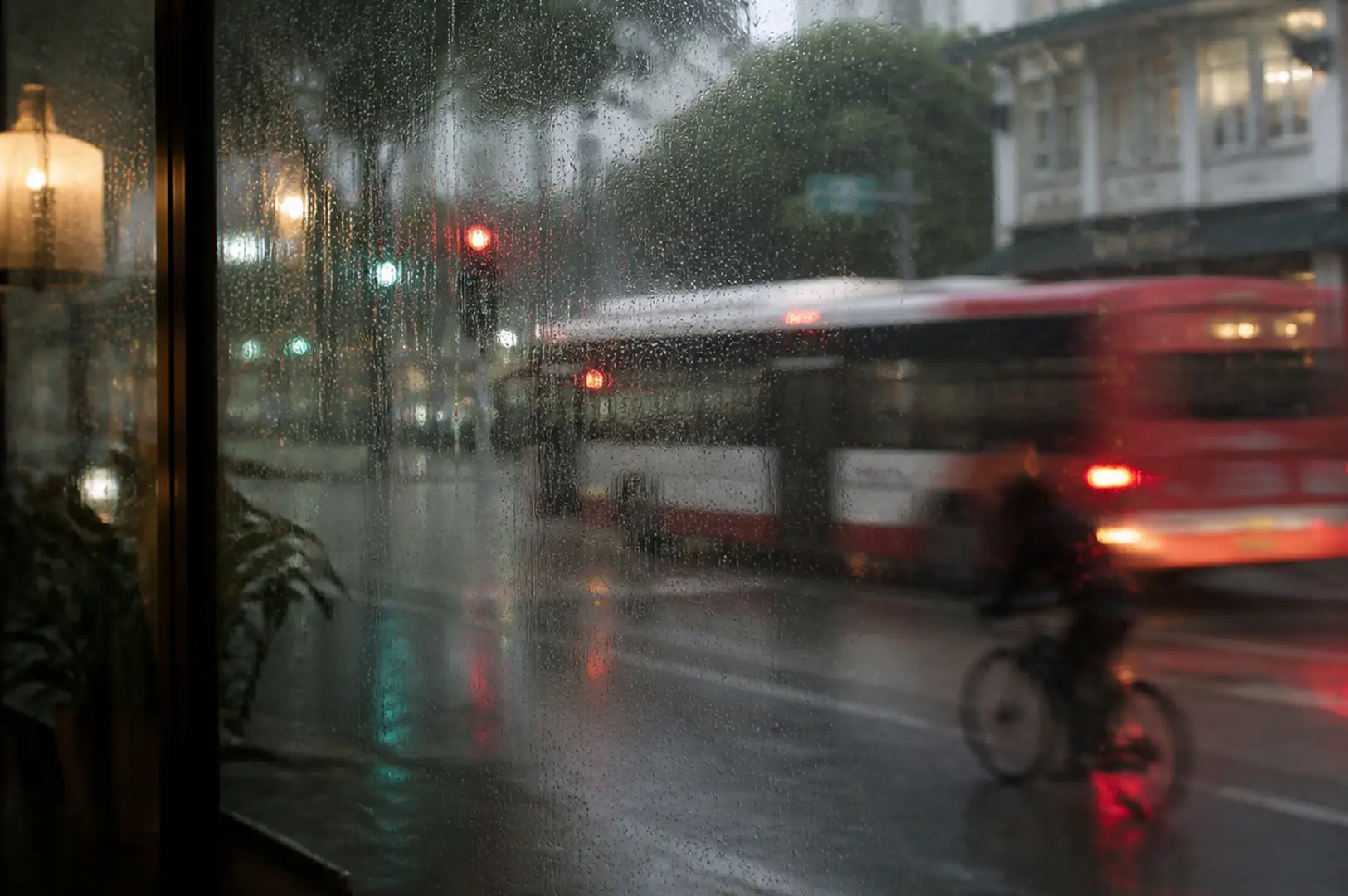
The first thing I notice is not the street.
It is the water.
A thin layer of condensation has gathered along the café window, softening everything beyond it. Outside, a bus moves past in a wash of red and white. A cyclist becomes a dark shape for two seconds, then disappears. Traffic lights dissolve into small pools of colour.
I could wipe the glass clean.
Instead, I leave it.
There is a habit in photography of wanting to clarify things. We sharpen. We focus. We wait for the subject to separate cleanly from the background. We talk about detail as if detail were always the point.
But Singapore does not always arrive that way.
Sometimes I see it through the misted window of a bus after rain, when the city becomes streaks of green, concrete, and reflected brake lights. Sometimes through the glass of an air-conditioned café, where the heat outside presses itself against the cool interior and turns the view uncertain.
Buildings lose their edges.
People become gestures.
A woman waiting at the crossing is no longer a portrait but a silhouette holding an umbrella. A row of old shophouses becomes colour before architecture. HDB blocks drift behind droplets like something remembered rather than observed.
I have come to like that uncertainty.
Technically, photographs like these can look imperfect. Autofocus may hesitate. Contrast falls away. Details that would normally anchor a frame are swallowed by haze or moisture.
That is precisely what interests me.
Condensation changes the distance between photographer and city. I am still looking at Singapore, but I am no longer pretending that I can see everything clearly.
There is something honest in that.
Cities are often remembered in fragments anyway. Not every place survives in the mind as a precise façade or street name. Sometimes what remains is the colour of evening through wet glass. The shape of someone stepping onto a bus. The yellow glow of a coffeeshop glimpsed while moving past.
The photograph begins to behave more like memory.
And Singapore, for all its sharp lines and polished surfaces, has many moments like this. Heat meeting air-conditioning. Rain giving way to humidity. Glass clouding over, then slowly clearing again.
For a few minutes, the city refuses to be exact.
I have learned not to rush that away.