
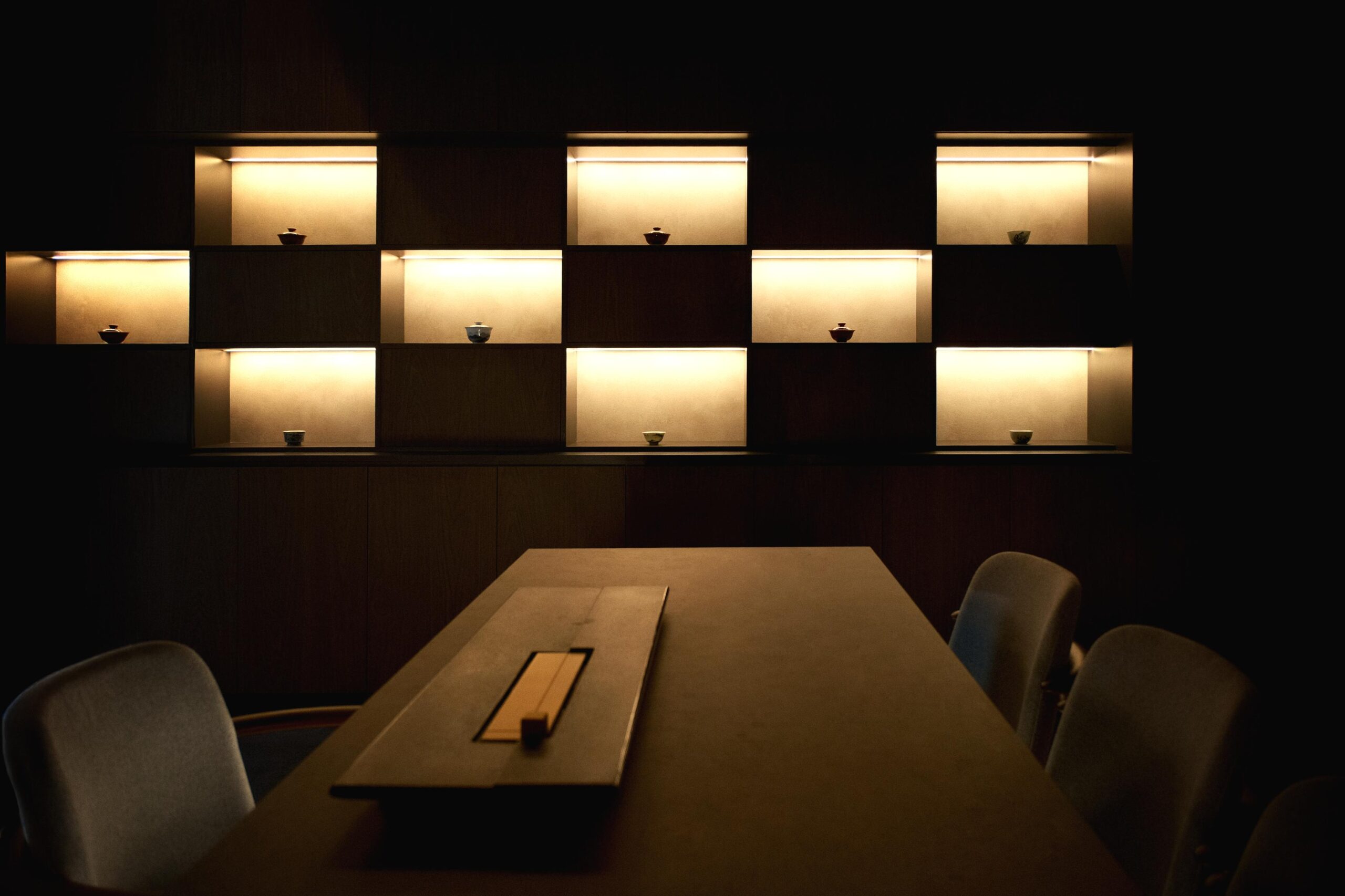
Some places give me images immediately.
I walk in, see the angles, notice the strongest lines in the room, and start building frames in my head before I even lift the camera. Tea Room by Ki-setsu was not like that for me. I expected it to be visually beautiful, and it was, but beauty was not the first thing that stayed with me. What stayed with me was how carefully the room seemed to protect silence.
That is not always easy to photograph.
Silence does not have an obvious shape. It does not announce itself the way colour, texture, or dramatic light does. It sits in the pause before a pour, in the empty space around a cup, in the way a table can feel complete without feeling crowded. When I started photographing the tea room, I realised very quickly that the room was asking me to slow down in the same way the tea was asking me to slow down.
I think that is what makes the space interesting.
The room is contemporary, but it does not feel eager to prove it. The design is clean, restrained, and deliberate, yet it never gives me the impression that tradition has been polished into something lighter or easier to consume. It also reminded me of why some spaces change the way we see. I did not feel like I was looking at a modern reinterpretation of Chinese tea culture in Singapore. I felt like I was standing inside a space that had been carefully cleared so the practice could remain visible.
That is a different thing entirely.
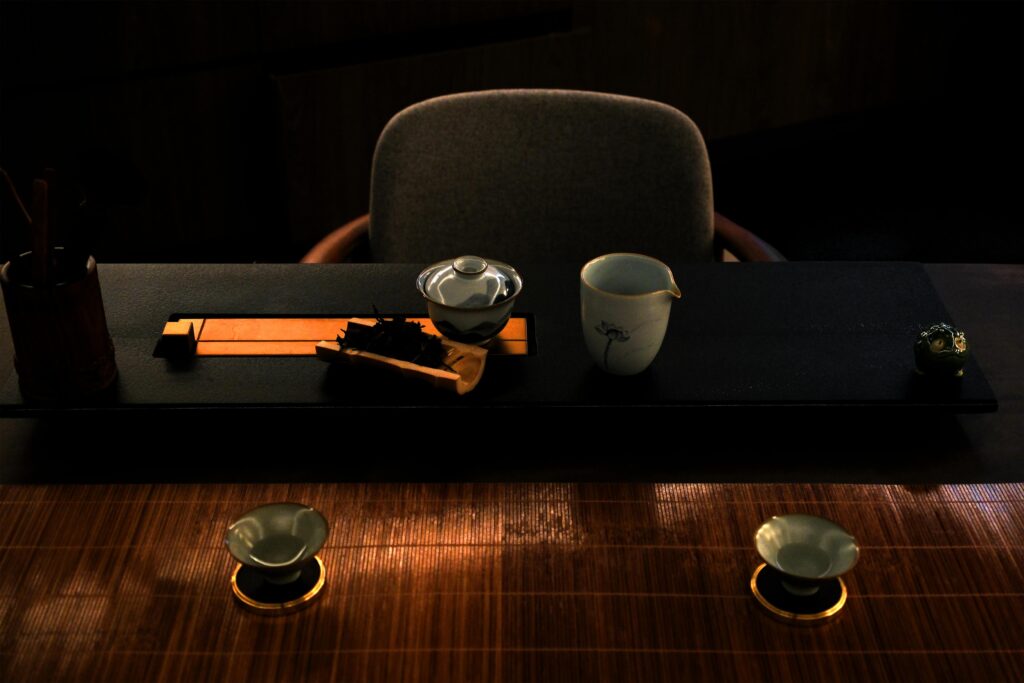
As I moved around the room, I kept noticing how little was competing for attention. The table held its place without dominating the frame. The shelves of teaware were beautiful, but not theatrical. The lighting was soft enough to quiet the room instead of turning it into a set. As a photographer, I am used to places trying very hard to become memorable. Here, the restraint was what made it memorable. Every time I tried to make the image bigger or more dramatic than it needed to be, the room pushed back gently. The better photographs came when I stopped chasing spectacle.
The tea service shifted my attention even more.
Once the session began, the room stopped being a room and became a rhythm. I started watching the smaller details instead of the wider compositions. The way the tea caught the light in a cup. The way steam softened the edge of a frame for only a second before disappearing. The way the teaware seemed to belong to the pace of the experience rather than simply decorate it. Those were the moments that felt honest to me.
I found myself thinking about how often tradition gets flattened when it enters modern spaces. It is either turned into performance or reduced to branding. That thought brought me back to earlier moments of photographing Singapore’s quieter forms of craft, especially in this journey with heritage artisans.
Tea Room by Ki-setsu did not feel like it was doing either. The room felt modern, yes, but the tea did not seem translated into a simpler language to match the setting. If anything, the setting seemed to step back so the older language of tea could remain intact.
That is probably the part I respected most.
I could feel it in the discipline of the service, in the emphasis on leaf and vessel, in the quiet authority of objects that did not need to explain themselves. Even without forcing the point, the experience made it clear that this was not tea as a decorative lifestyle gesture. It was tea approached with method, patience, and seriousness. Photographing that changed the way I saw the room. I came in noticing surfaces. I left thinking about continuity.
There is one image from the visit that keeps coming back to me. It is not the widest shot of the room or the most obviously polished composition. It is a close frame of tea in a cup, held in quiet light, with just enough detail around it to suggest the ritual without explaining everything. That photograph felt closest to the truth of the place. Not because it showed everything, but because it trusted stillness.
I think that is what Tea Room by Ki-setsu does well. It trusts that tradition does not always need to be made louder to survive. Sometimes it only needs a room that knows how to hold it carefully.
And maybe that was the real journey for me as a photographer. I went in expecting to document a beautiful tea room. I left feeling like I had spent time inside an argument for restraint. Not old versus new, not heritage versus design, but something more difficult and more convincing. A reminder that contemporary spaces do not have to dilute old practices. Sometimes they can shelter them.