
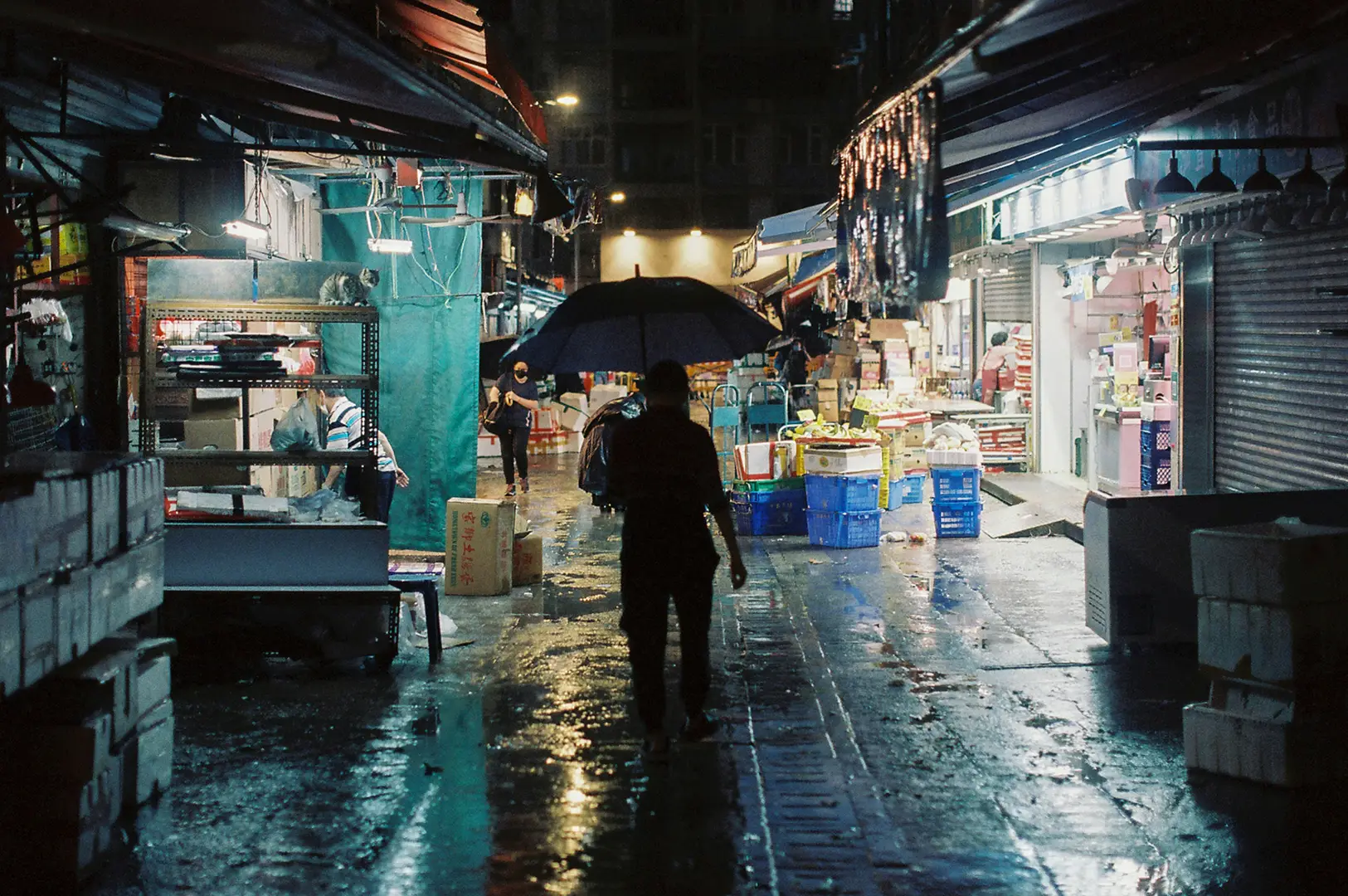
I have always liked the ten minutes after everyone goes home.
Not the dramatic emptiness of midnight, but the softer kind that arrives just after a place has been used up for the day. Plastic chairs sit slightly out of line. A paper cup rolls once, then stops. Somewhere nearby, a cleaner drags a bin across the floor.
The crowd is gone, but its shape is still there.
I notice this often in Singapore.
A wet market after the morning rush feels completely different from the version most people remember. The shouting has stopped. The floor is wet from washing. Crates sit empty beneath stainless-steel counters, and the fluorescent lights suddenly seem too bright for the silence.
At playgrounds, the change is gentler.
A swing moves without anyone on it. Chalk marks remain on the pavement. A forgotten water bottle waits beside a bench as if someone might come running back for it.
Festival grounds are stranger still.
I have walked through public spaces shortly after an event ends, when barriers are being folded, cables are being gathered and workers are pulling banners down one corner at a time. A few hours earlier, the same ground might have been crowded with music, food, conversations, and people trying to move in opposite directions.
Then the volume disappears.
That is usually when I start looking more carefully.
Photographing a busy place is often about timing between people. I watch gestures, crossings, layers. After the crowd leaves, the problem changes. There are fewer subjects to rely on. Small objects begin carrying more weight inside the frame.
A stack of abandoned trays can tell you there was a meal.
Flattened grass can tell you where people stood.
A row of temporary lights still glowing over an empty field can make the absence itself visible.
I have come to think of these scenes as a kind of afterimage.
Singapore moves quickly. Markets close, decorations come down, playgrounds empty when rain starts, public spaces are cleaned and reset for the next day. We are good at restoring order.
Photography lets me stay with the untidy interval before that happens.
There is something honest in it.
Not sadness, exactly. I am not interested in turning every empty chair into a metaphor. Sometimes an empty chair is simply an empty chair.
But traces matter.
They remind me that public spaces are not defined only by architecture. They are shaped by the people who pass through them, even after those people are no longer visible.
So I sometimes arrive late on purpose.
Not for the event.
For what it leaves behind.