
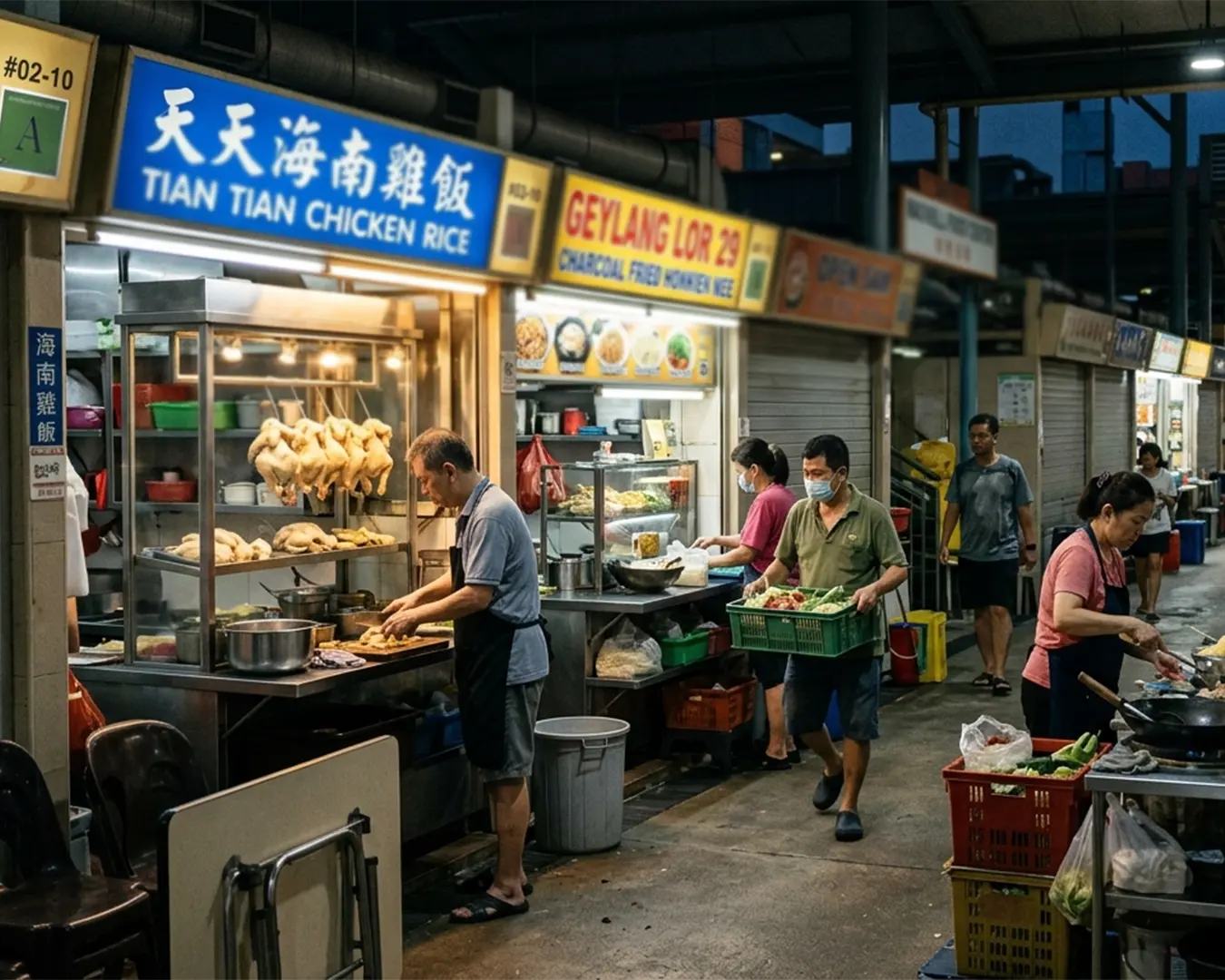
Singapore feels different before sunrise.
Not quieter, exactly—but softer. The city hasn’t fully stepped into itself yet. Office towers remain dark, MRT platforms are half-empty, and the usual rhythm of movement slows into something almost careful.
At 5AM, hawker centres begin breathing long before customers arrive.
The first thing you notice isn’t the smell of food. It’s the sound.
Metal shutters rolling upward. Plastic stools dragging across tiled floors. Knives tapping against chopping boards with practiced rhythm. Somewhere in the distance, a kettle whistles. Water rushes through worn sinks. A hawker clears their throat before starting another morning they’ve already lived hundreds of times before.
This is the version of Singapore most people never see.
By breakfast hour, these places will become loud with conversation and movement. But before the crowds arrive, there’s a strange intimacy to it all. The silence between sounds becomes noticeable. Every gesture feels heavier, more deliberate.
This is what I usually say at SG Nomad Photographer, photographing during these hours changes the way you see hawker culture.
In the daytime, it’s easy to focus on the finished dish—the color, the steam, the rush of service. But at dawn, the story shifts toward preparation. Toward repetition. You begin noticing the labor hidden behind familiarity.
At Chinatown Complex, the fluorescent lights flicker against wet floors still drying from the morning wash. Vendors unpack ingredients in near silence. An elderly man folds napkins with mechanical precision while another arranges bowls into perfect stacks. Nobody performs for the camera at this hour. They are too busy preparing the day.
That honesty is what makes these mornings worth documenting. There’s no spectacle here. No curated version of heritage designed for attention. Just routine unfolding naturally, without interruption. A city quietly feeding itself before it fully wakes.
And somewhere between the clatter of utensils and the hum of exhaust fans, you realize hawker centres are more than food spaces. They are soundscapes of survival, memory, and repetition. Every stall carries its own rhythm. Every movement reflects years of muscle memory sharpened by necessity.
By 7AM, the spell begins to break. The crowd arrives. Conversations overlap. Trays slam onto tables. The city becomes itself again. But for a brief moment before sunrise, Singapore belongs to the people preparing it. It’s a futile, yet important moment, and that actual feeling when the camera stops feeling like a stranger. And if you listen carefully enough, you can hear the entire day beginning.