I once turned up for a shoot expecting the building to be the subject.
It wasn’t.
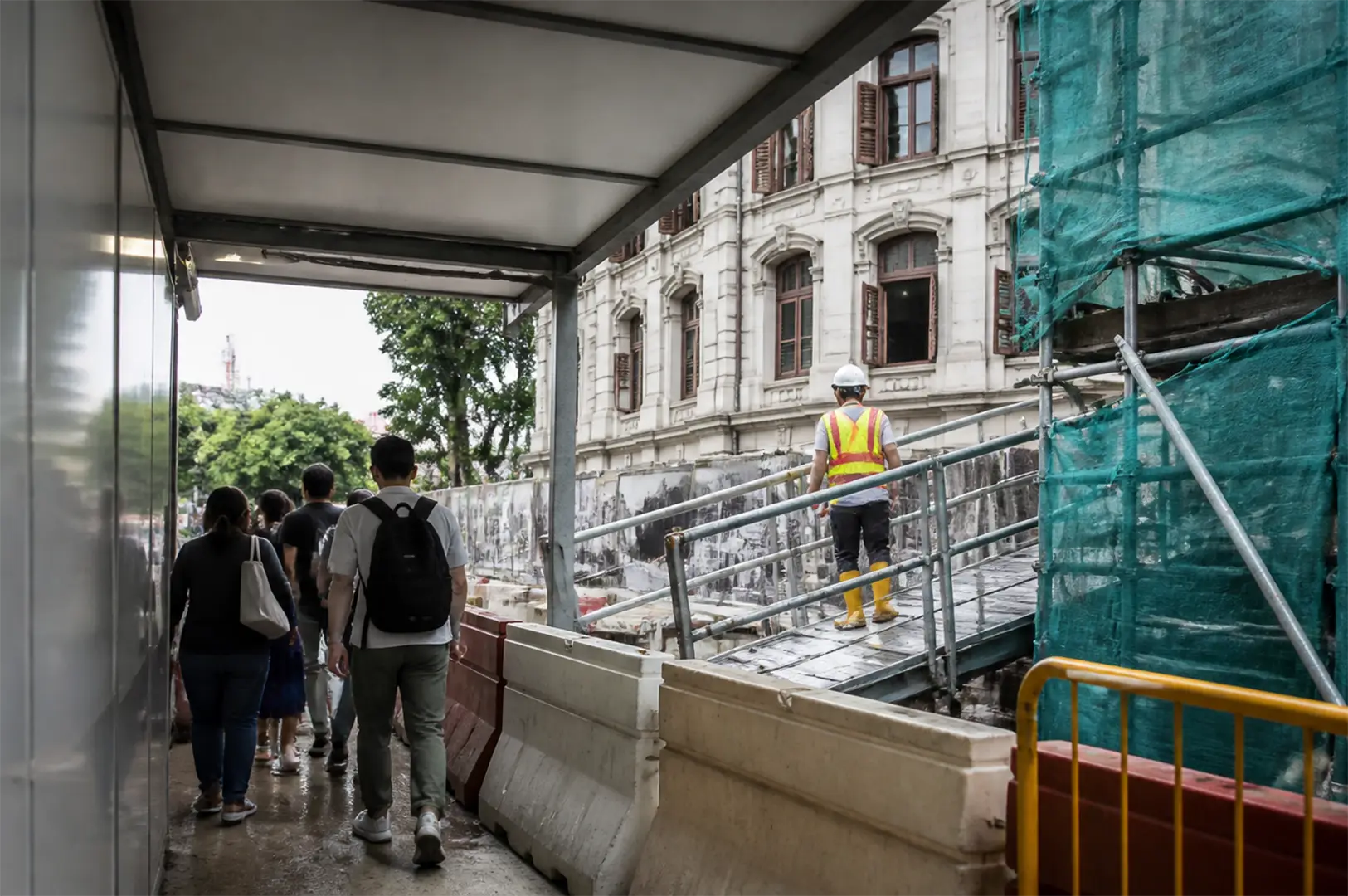
Half the frontage was hidden behind hoarding. A temporary covered walkway cut across the frame. Metal barriers redirected pedestrians around a work zone. Someone had pasted fresh notices onto plywood panels, and a worker in a reflective vest kept appearing where I had planned to place my camera.
At first, I was irritated.
Then I realised the temporary structures were telling the better story.
Photographers tend to treat construction fencing, scaffolding, temporary shelters and diverted paths as visual clutter. We wait for the clean view. We crop around the mess. We tell ourselves we will come back when the work is finished.
Sometimes that is exactly the wrong instinct.
Singapore changes quickly enough that temporary architecture becomes part of how the city looks and feels. A covered passage beside a mall renovation, an event structure outside a civic building, a block wrapped in mesh before works begin, these are not interruptions to the city. They are evidence of the city changing in real time.
I have become less interested in photographing only the finished version.
When I find something temporary now, I work through a simple sequence. First, I photograph the structure itself. Then I step back and include whatever permanent architecture surrounds it. After that, I wait for people to use the space as intended, squeezing through a narrowed path, reading a notice, walking beneath a temporary roof. If the site matters to me, I return later.
That last part is important.
A temporary structure can disappear before you think to photograph it properly. I have gone back to locations assuming a barrier, mural, shopfront or worksite would still be there, only to find bare walls or an entirely new frontage.
That used to frustrate me more than it does now.
Photography cannot stop change. It can only be specific about what was there.
There is also something useful about leaving the mess in the frame. Construction mesh against an old façade. A temporary ramp beside a staircase. Safety signs beneath ornate shophouse details. These combinations say more about Singapore than a perfectly isolated landmark sometimes can.
They show a city being adjusted while people continue using it.
I still like clean architectural photographs. I still wait for good light and uncluttered lines when the image calls for it.
But I no longer assume the temporary parts are mistakes.
Sometimes the plywood, scaffolding and barriers are the photograph.
Sometimes they are the only proof that a particular version of Singapore ever existed.