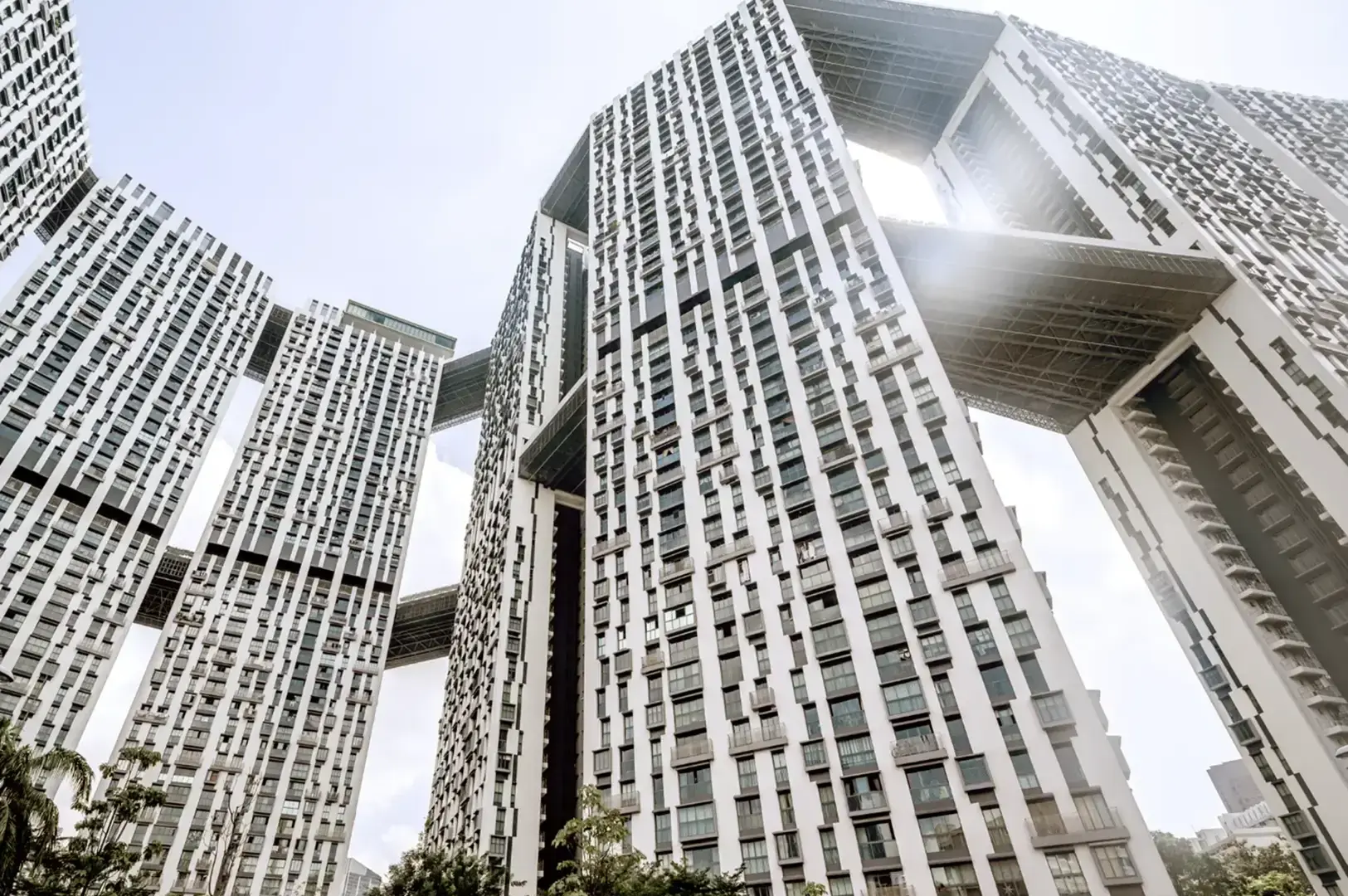
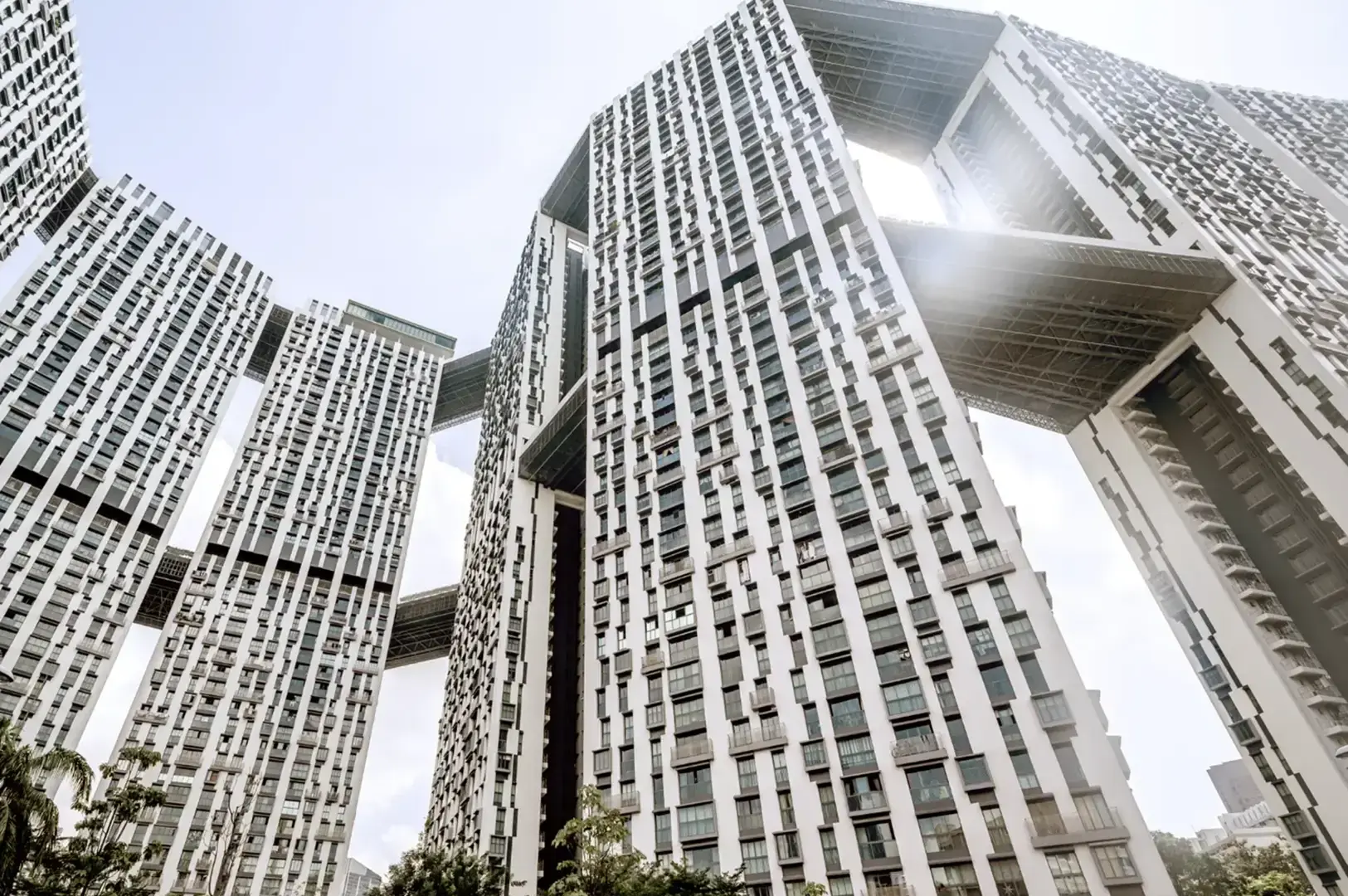
Somewhere above you, a window is lit.
Perhaps there is a shirt hanging from a bamboo pole, a plant leaning towards the last of the daylight, or a curtain drawn halfway across the glass. From the ground, there is no telling what happens behind it. You see only the window, one small rectangle among hundreds.
I have always found something quietly moving about HDB in Singapore. So many lives contained within buildings that, from a distance, appear almost identical. A familiar arrangement of concrete, windows and corridors, repeated across the island. Yet every illuminated window belongs to a different story.
We have become so accustomed to these buildings that we sometimes forget to look at them.
Before the Housing & Development Board
In Tiong Bahru, the buildings tell an older story.
Before the Housing & Development Board existed, the Singapore Improvement Trust built flats here between 1936 and 1941. Designed by Alfred G. Church in a modified Streamline Moderne style, the pre-war blocks have curved corners, horizontal bands, cantilevered shades, and patterned brickwork. Some windows resemble the portholes of a ship. The National Heritage Board's heritage page documents these architectural details, and twenty pre-war blocks were conserved in 2003.
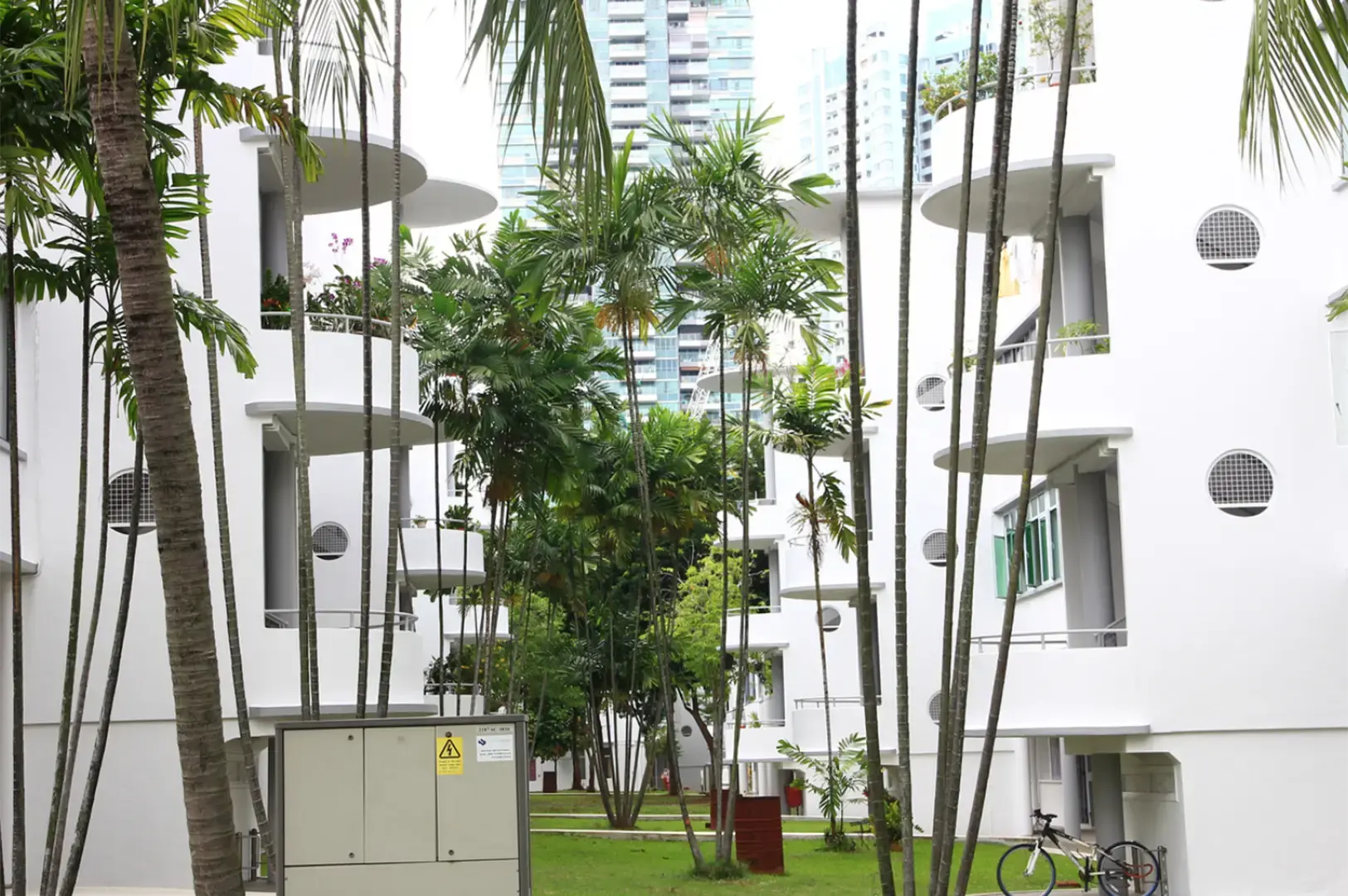
There is a certain gentleness to those curves. The buildings seem to turn with the street rather than interrupt it. Their horizontal lines draw the eye around corners, while the brickwork gives the walls a texture that becomes more apparent the longer one looks.
These are not HDB flats. They belong to the chapter before the development board began reshaping Singapore's housing landscape.
And yet, they introduce a question that would follow the city for decades: How do you build enough homes for a growing population without losing the character of the places people inhabit?
The answer would eventually rise much higher than these early flats.
The Development Board and a Nation Learning to Live Upward
The Housing & Development Board was established on 1 February 1960, succeeding the Singapore Improvement Trust. As a statutory board under the Ministry of National Development, it became part of the Government of Singapore's response to a severe housing shortage.
Within three years, HDB had completed more than 21,000 flats.
I find it difficult to look at that figure without imagining the individual households behind it. A number on a page tells us how quickly buildings went up. It tells us less about what it meant to leave overcrowded accommodation for a flat with modern sanitation and a door of one's own.
In 1964, the Home Ownership for the People Scheme made HDB flats available for sale, rather than rent alone. From 1968, eligible buyers could use their Central Provident Fund savings towards housing. The process of acquiring a home would evolve over the decades, with households able to apply for flats, receive their keys and, subject to HDB's rules, eventually sell their homes.
Housing became more than the provision of shelter. For many families, it became a way to put down roots.
Today, HDB reports having built more than 1.25 million flats, and about 80% of Singapore's resident population lives in HDB housing.
In Toa Payoh, the first town comprehensively planned and developed by HDB, that scale becomes visible. Residential blocks rise around a town centre, connected by walkways and the familiar infrastructure of neighbourhood life.
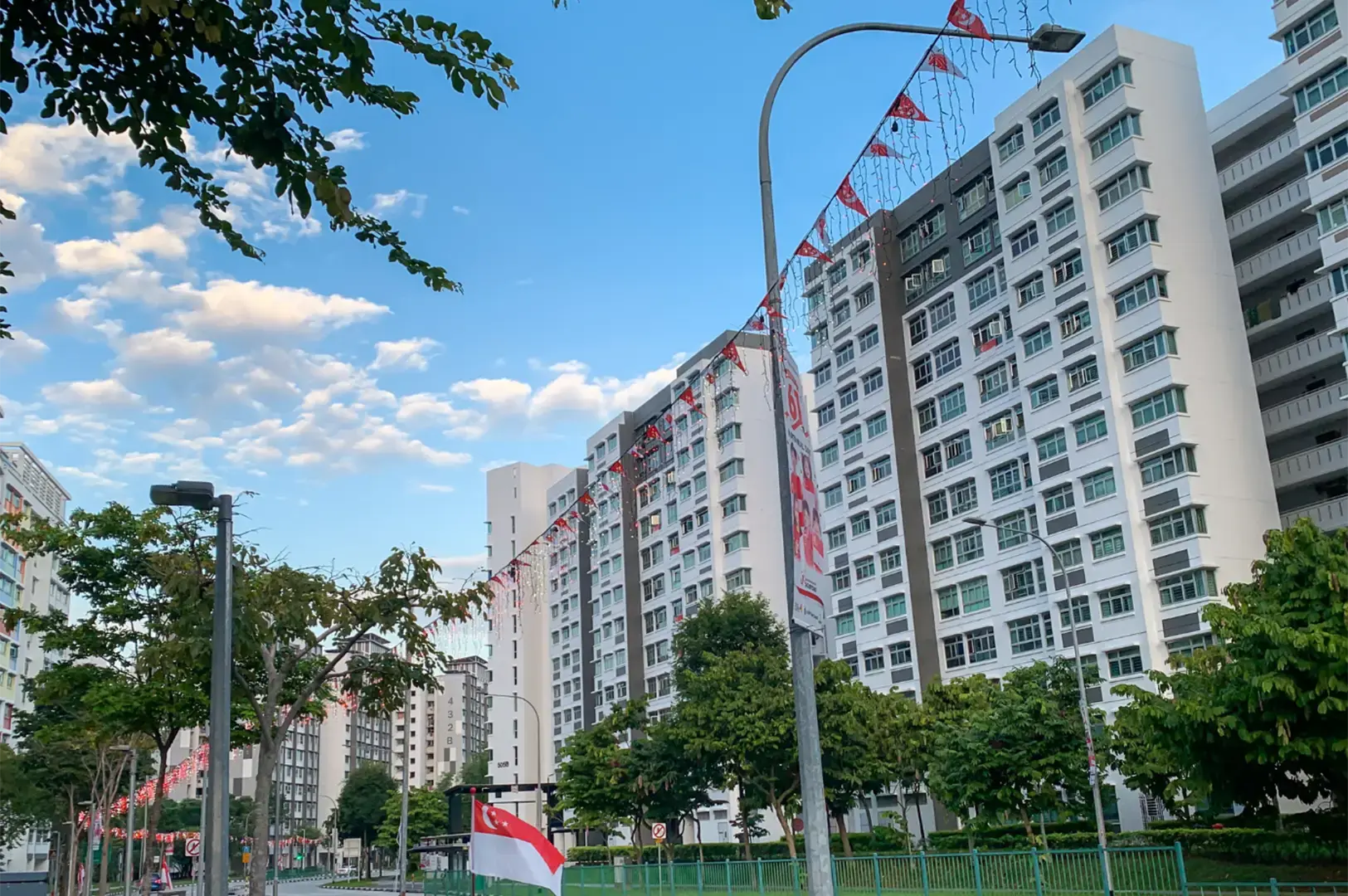
The buildings are tall, but what interests me is everything happening at their feet.
A walkway connects one block to another. A pedestrian crosses the open space between buildings. Shops sit within reach of the flats above. The neighbourhood has its own rhythm, one that cannot be understood by looking at the skyline alone.
A housing estate is not simply a collection of homes. It is the distance between them, and everything that fills that distance.
The Spaces Between Homes
Beneath the residential floors, the void deck opens into a different kind of space.
Concrete columns stand in orderly rows. Beyond them, daylight reaches the pavement, while the interior remains sheltered from the sun. There are no walls separating the space entirely from the street. The neighbourhood seems to pass through the building rather than stop at its entrance.
Some void decks contain benches or tables. Others serve mainly as passages between lifts, walkways and the surrounding estate. HDB has also incorporated seating near letterboxes and lift lobbies, alongside community gardens and multigenerational facilities, to encourage interaction.
But a space designed for community does not automatically become one.
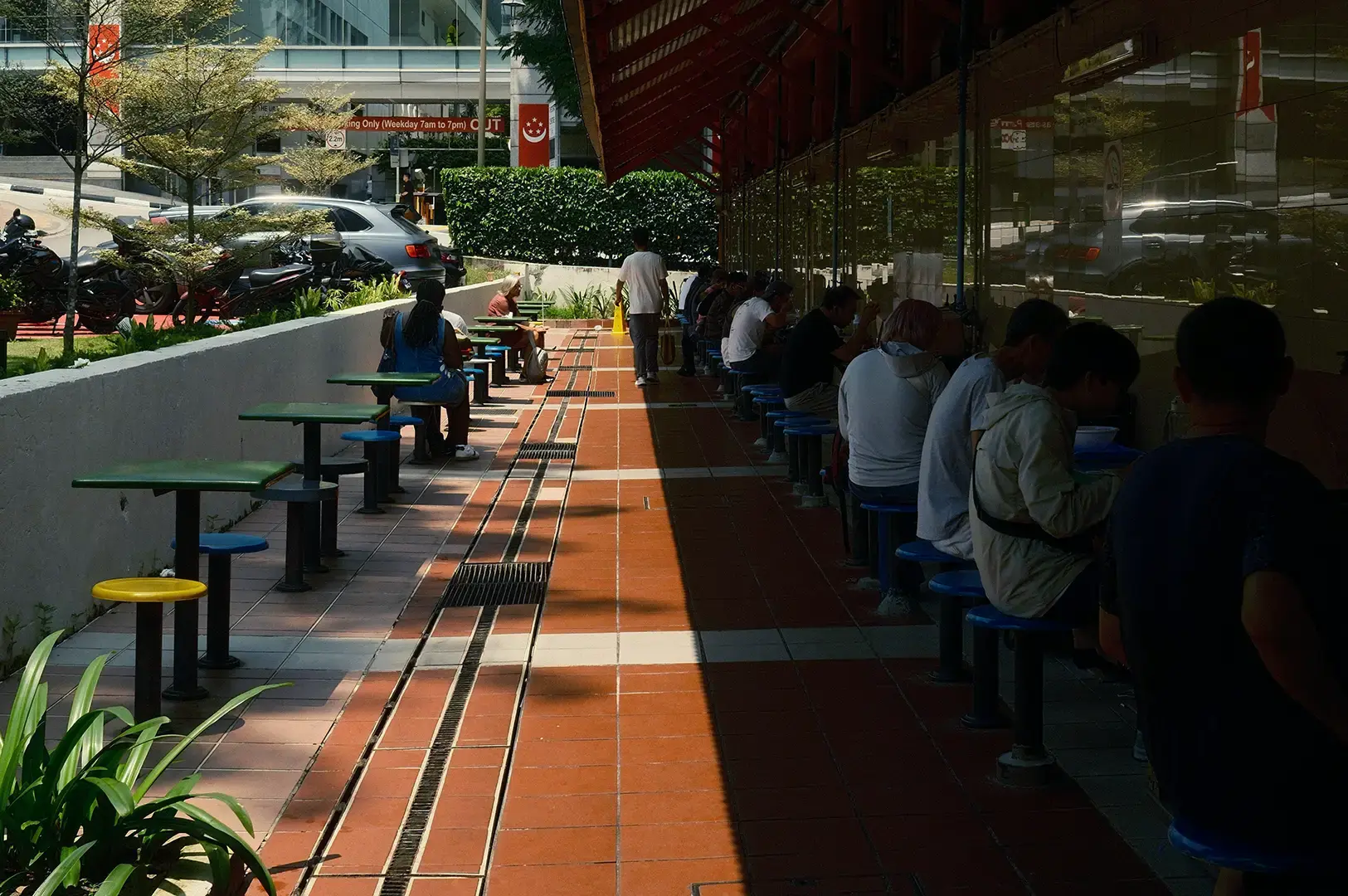
A bench can hold a conversation, a moment of rest, or nothing at all. The same sheltered corner might be occupied at one hour and empty at another.
I think that uncertainty is part of what makes these places interesting. We often speak about community as though it were something permanently present, something a building can guarantee simply by making room for it. But community is made of smaller, less predictable things. A familiar face. A brief exchange. The comfort of recognising someone without necessarily knowing their name.
There is no grand architecture to those moments.
Only the space that allows them to happen.
What the Corridors Keep
Higher up, the shared spaces narrow. A corridor stretches past a succession of doors. The floor tiles repeat. The metal gates follow a similar order. The walls carry the same colour until something interrupts the pattern.
A pot of plants. A pair of slippers. A different gate. Perhaps a small decoration beside a doorway.
I could make a list of these details, but that would miss what makes them meaningful. None is particularly remarkable on its own. Together, they reveal the quiet ways people distinguish one home from another.
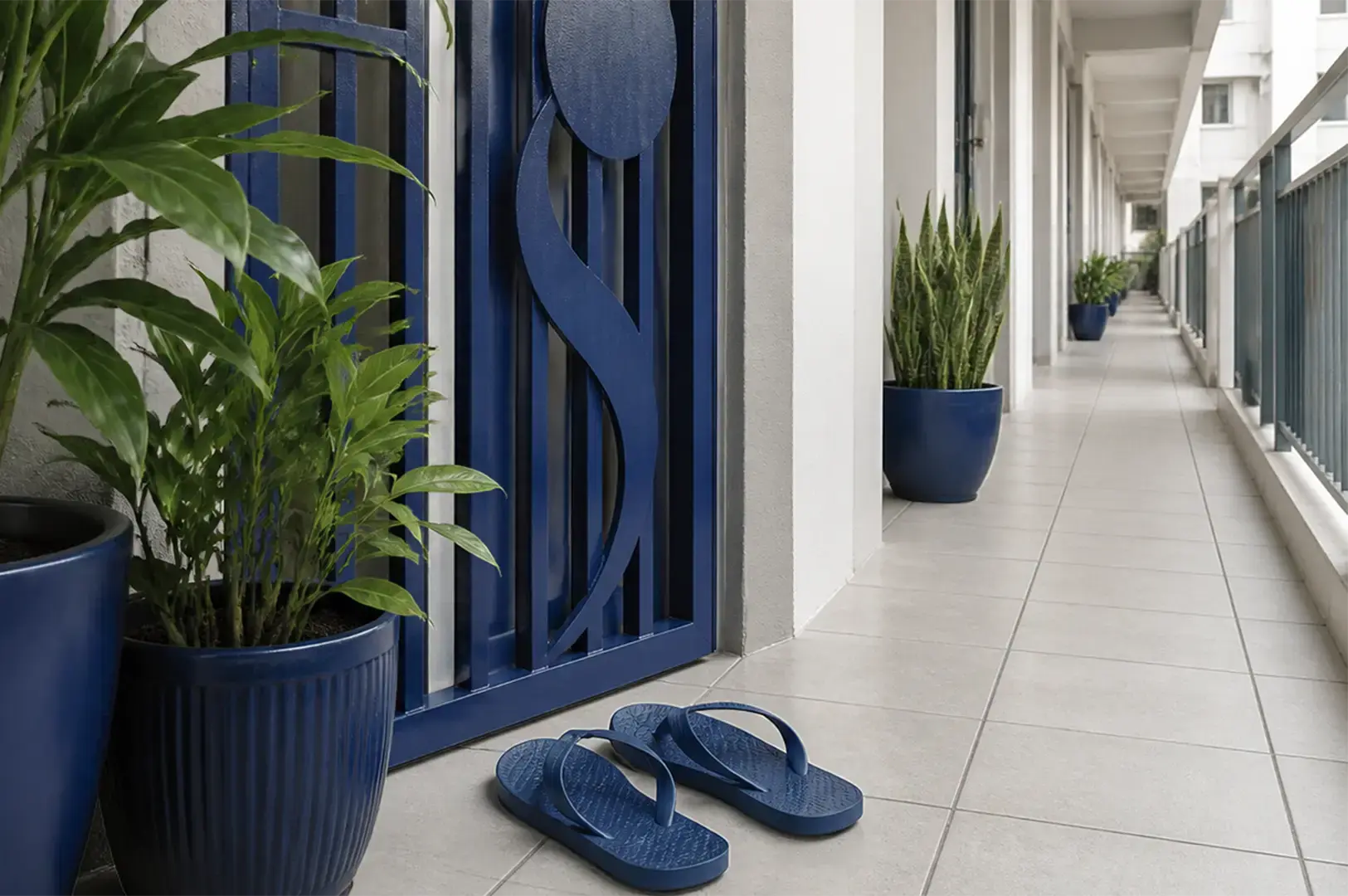
The architecture repeats. The lives behind it do not.
There is something intimate about a corridor, even when it is shared. It belongs to no single household, yet it sits immediately outside so many private worlds.
A closed door tells us almost nothing about the people behind it. We might see a plant receiving sunlight or a pair of shoes placed neatly beside the entrance. Beyond that, the story belongs to someone else.
This is where I think HDB photography asks for a particular kind of restraint. Not every open doorway is an invitation. Not every glimpse of domestic life needs to become a photograph.
Some boundaries deserve to remain boundaries.
Perhaps that is why the smallest details outside a home can be so affecting. They suggest a life without claiming to explain it.
Queenstown and the Generations of a Skyline
In Queenstown, the passage of time is written across the buildings themselves.
The estate contains different generations of public housing. HDB's town design guide identifies distinctive areas such as Stirling and Dawson, including the brick-faced residential blocks of Stirling.
The differences are not always dramatic. Sometimes they appear in the materials of a facade, the proportions of a window or the distance between buildings. Elsewhere, the contrast is unmistakable: older residential forms standing within sight of taller, newer developments.
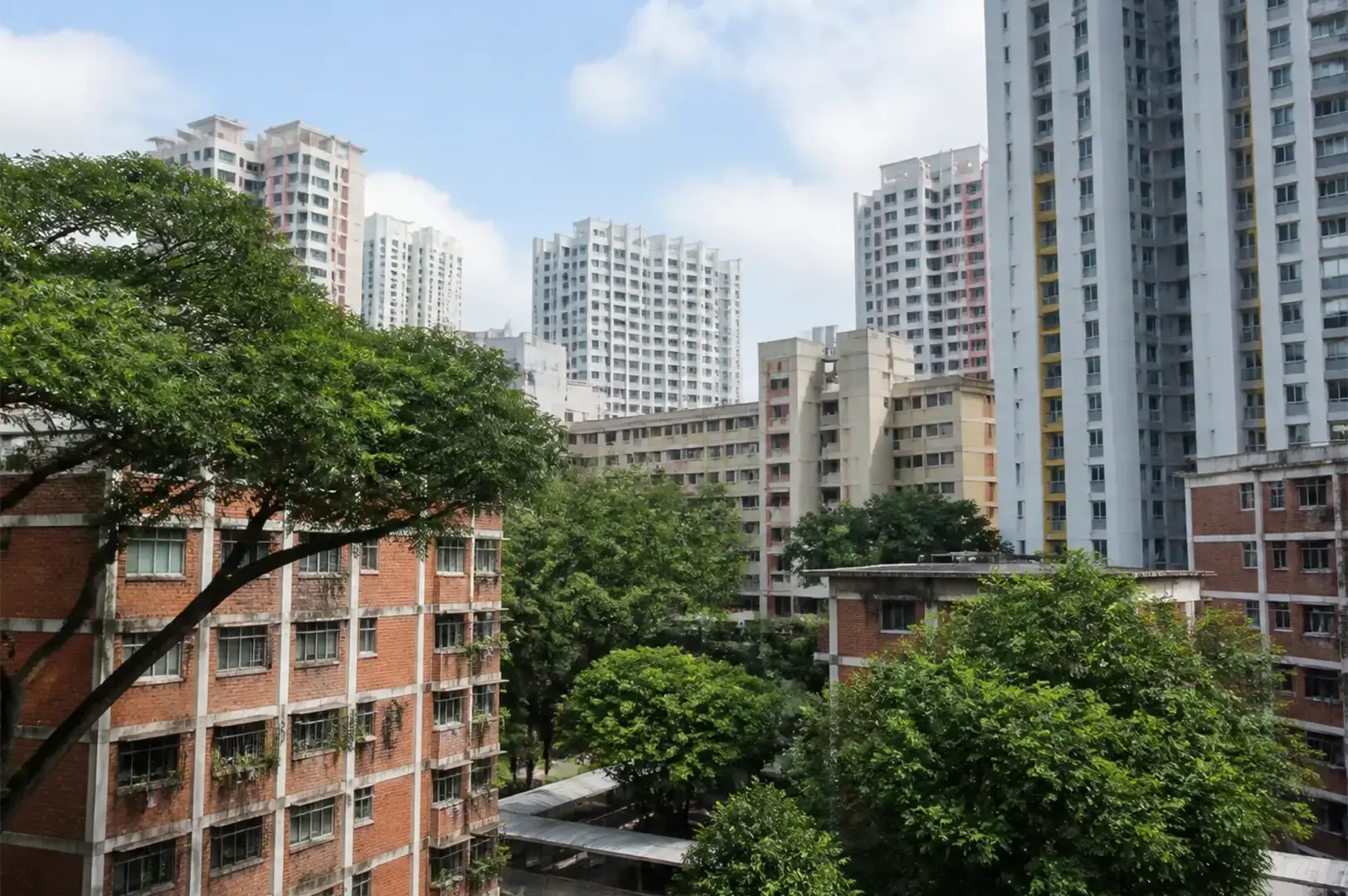
From a distance, the skyline seems to compress the years.
Buildings from different periods occupy the same view. Trees soften the straight edges. A taller block rises behind a lower one, and the spaces between them offer brief glimpses of another street, another building, another layer of the estate.
Singapore's housing landscape is not one finished picture. It is a place continually being added to.
That is what draws me to the relationship between wide views and smaller details. A skyline can show the scale of change, but a worn surface or familiar doorway gives that change something human to rest against. The meaning emerges through the relationship between photographs in visual storytelling, rather than through one image expected to explain everything.
I think about a similar tension in photographs of Singapore's traditional trades and the quiet traces they leave. A tool, a workbench, or an ageing shopfront can hold evidence of a way of life that the wider city barely notices.
An HDB neighbourhood can contain those same small histories. A longstanding shop, a familiar repair counter, a business occupying the ground floor of a residential block. Their presence must be observed rather than assumed, but when they are there, they belong to the story of the estate as much as the buildings above.
A place changes in large ways and small ones. Often, it is the smaller changes we struggle to name.
How Light Moves Through HDB in Singapore
There is another kind of change that happens without a single wall being altered.
Light.
Singapore's tropical climate brings frequent rain, high humidity, and sudden changes in the sky. The Meteorological Service Singapore records long-term average relative humidity of about 82%.
In the early morning, light may enter a corridor from the side, drawing long shadows across the floor. By midday, the walls facing the sun can become almost painfully bright, while the void deck beneath them stays in shade.
After rain, concrete takes on a darker tone. Water gathers in shallow depressions along the pavement, holding broken reflections of the buildings above. Somewhere along the sheltered edges, droplets continue to fall after the rain has stopped.
Then evening arrives. The sky loses its brightness. The outlines of the blocks soften. One window lights up, followed by another. What was a uniform facade in daylight becomes a scattered arrangement of illuminated rooms.
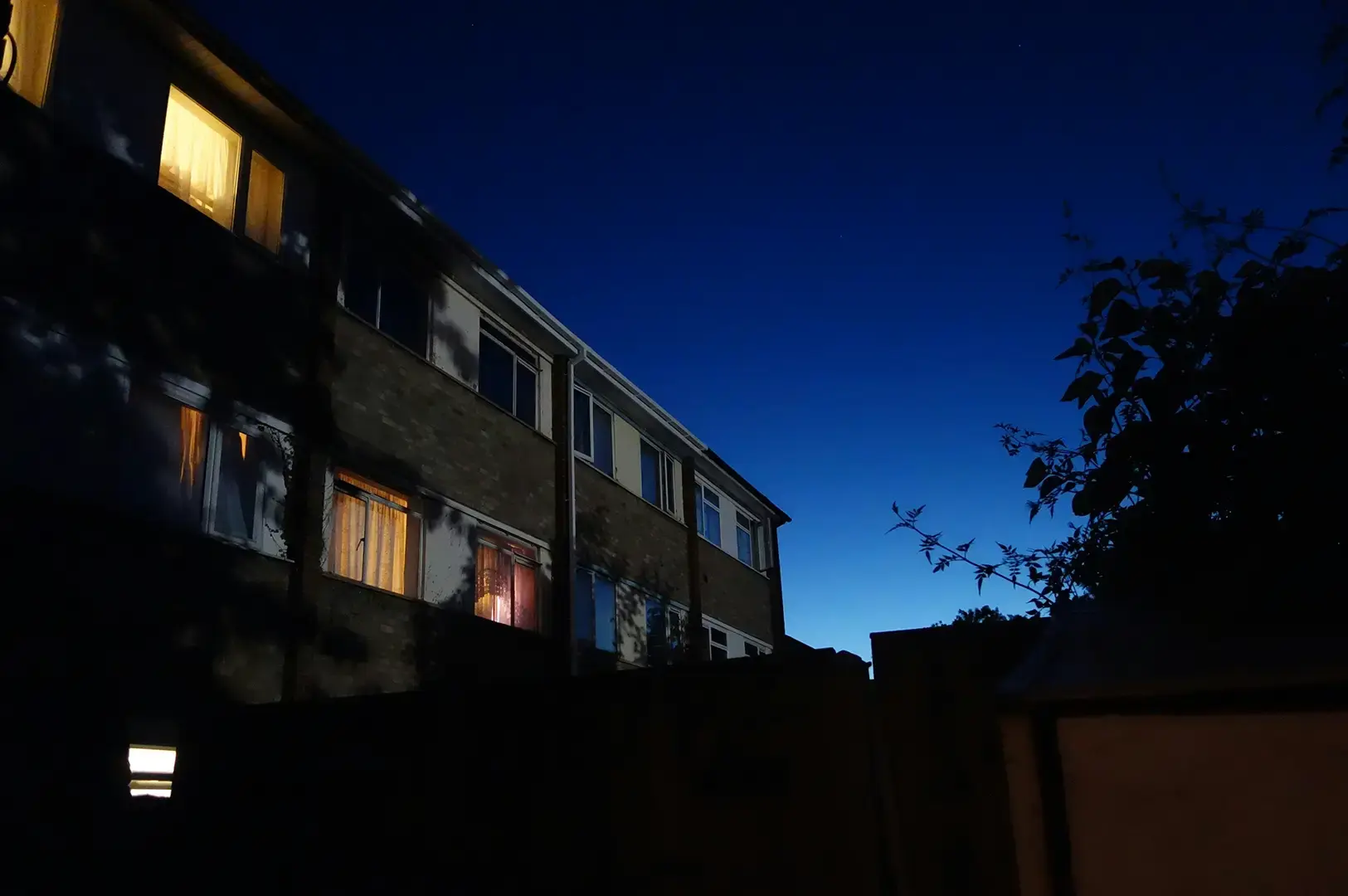
I find this the most quietly revealing moment of all.
During the day, the building is an arrangement of floors and windows. At dusk, the lights remind us that every rectangle belongs to a separate household.
Someone may have just returned home. Another household may be preparing dinner. Others may not be home yet. We cannot know from the pavement below.
The architecture hasn't changed, but the meaning of the photograph has.
A building that seemed almost anonymous in daylight begins to suggest the private lives it contains.
The light keeps rewriting what we thought we knew.
The Door You Don't Open
When I think about HDB in Singapore, I think about how easily these buildings become background.
We pass them on the way to work. We recognise their outlines from a train window. We remember them by block numbers, bus stops, and the shops nearby. There are so many that it is tempting to see them as one continuous landscape.
But I don't think home can ever be understood at that scale alone.
It is there in the shared spaces beneath the flats, in the plants outside a doorway, in the buildings that have watched a neighbourhood change. It is there in the ordinary things that rarely receive much attention until someone stops to notice them. And perhaps that is what stays with me most.
A photograph can hold the facade of a building. It can show the windows, the corridors, the small evidence of people living close to one another.
But it cannot contain everything that makes those lives their own.
Somewhere above you, a window is lit.
You won't see inside. You don't need to.
The home is already there, just past the threshold.